
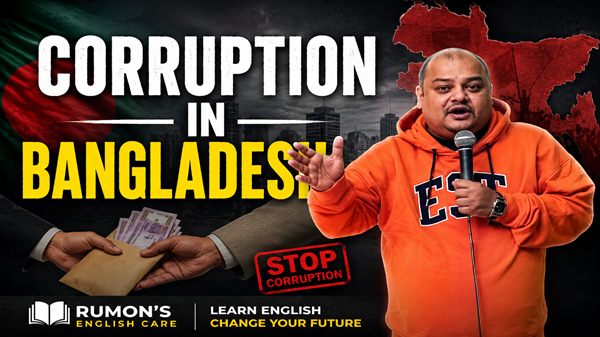
Corruption in Bangladesh
Corruption in Bangladesh
Corruption is one of the greatest challenges facing Bangladesh today. It is a social, economic, and political problem that hinders national development and weakens public trust in institutions. Corruption means the misuse of public power or authority for personal gain. It includes bribery, embezzlement, nepotism, fraud, abuse of power, and favoritism. Although Bangladesh has made remarkable progress in many sectors such as education, healthcare, infrastructure, and economic growth, corruption remains a major obstacle to achieving sustainable development and ensuring good governance.
Corruption exists in many sectors of Bangladesh. It can be found in government offices, business organizations, educational institutions, law enforcement agencies, healthcare services, and even in some non-governmental organizations. Many people have to pay bribes to obtain basic public services, official documents, or government approvals. In some cases, jobs are secured through political influence or personal connections rather than merit and qualifications. Such practices discourage honest and talented individuals and create inequality in society.
There are several causes of corruption in Bangladesh. One of the main causes is the lack of transparency and accountability in public administration. Weak enforcement of laws often allows corrupt individuals to escape punishment. Political influence, bureaucratic delays, and poor monitoring systems also encourage dishonest practices. Low salaries in some public sectors, combined with greed and a desire for quick wealth, motivate some officials to engage in corruption. Moreover, a lack of moral education and ethical values contributes to the spread of corrupt behavior.
The effects of corruption are severe and far-reaching. It slows down economic growth by discouraging both local and foreign investment. Development projects often become more expensive due to the misuse of public funds and irregularities in procurement. As a result, roads, bridges, schools, hospitals, and other public facilities may be poorly constructed or left incomplete. Corruption also widens the gap between the rich and the poor because public resources are not distributed fairly. The poor suffer the most, as they often cannot afford to pay bribes for essential services.
Corruption also damages the quality of education and healthcare. When admission, recruitment, or examination results are influenced by bribery or favoritism, deserving students and qualified professionals are deprived of opportunities. Similarly, corruption in the healthcare sector can lead to the misuse of medical supplies, poor-quality services, and unequal access to treatment. These problems reduce public confidence in state institutions and weaken the rule of law.
Another harmful consequence of corruption is the erosion of moral values. When dishonest individuals achieve success through illegal means, young people may lose faith in honesty and hard work. This creates a culture where corruption becomes socially accepted. Over time, such a culture weakens patriotism, justice, and social harmony. A nation cannot progress if corruption becomes a normal part of everyday life.
To combat corruption, both the government and citizens have important responsibilities. The government should ensure transparency, strengthen the judicial system, and enforce anti-corruption laws without political interference. Public officials who are found guilty of corruption should receive strict and impartial punishment. Digital governance, online public services, and electronic payment systems can reduce direct contact between officials and citizens, thereby minimizing opportunities for bribery. Independent institutions responsible for preventing corruption should be provided with sufficient authority and resources to perform their duties effectively.
The media and civil society also have significant roles to play. Investigative journalism can expose corruption and raise public awareness. Educational institutions should promote moral values, honesty, and civic responsibility among students. Families should teach children the importance of integrity and respect for the law from an early age. Religious and community leaders can also encourage ethical behavior and condemn corrupt practices.
Every citizen has a role in building a corruption-free Bangladesh. People should refuse to offer or accept bribes, report corrupt activities, and support transparency in both public and private life. Honest leadership, active public participation, and a strong commitment to justice are essential for reducing corruption. Modern technology, including digital record-keeping and e-governance, can further increase transparency and accountability.
In conclusion, corruption is a serious threat to the progress, stability, and reputation of Bangladesh. It wastes national resources, weakens institutions, and creates injustice in society. However, corruption is not an unavoidable problem. With effective laws, transparent governance, responsible leadership, and active participation from citizens, Bangladesh can significantly reduce corruption and build a fair, prosperous, and accountable society. The dream of a developed and prosperous Bangladesh can only be achieved when honesty, integrity, and the rule of law become the guiding principles of both public and private life.
or,
Corruption
Corruption refers to a form of criminal activity or dishonesty. It refers to an evil act by an individual or a group. Most noteworthy, this act compromises the rights and privileges of others. Furthermore, Corruption primarily includes activities like bribery or embezzlement. However, Corruption can take place in many ways. Most probably, people in positions of authority are susceptible to Corruption. Corruption certainly reflects greedy and selfish behavior.
First of all, Bribery is the most common method of Corruption. Bribery involves the improper use of favours and gifts in exchange for personal gain. Furthermore, the types of favours are diverse. Above all, the favours include money, gifts, company shares, sexual favours, employment, entertainment, and political benefits. Also, personal gain can be – giving preferential treatment and overlooking crime.
Embezzlement refers to the act of withholding assets for the purpose of theft. Furthermore, it takes place by one or more individuals who were entrusted with these assets. Above all, embezzlement is a type of financial fraud.
The graft is a global form of Corruption. Most noteworthy, it refers to the illegal use of a politician’s authority for personal gain. Furthermore, a popular way for the graft is misdirecting public funds for the benefit of politicians.
Extortion is another major method of Corruption. It means to obtain property, money or services illegally. Above all, this obtainment takes place by coercing individuals or organizations. Hence, Extortion is quite similar to blackmail.
Favouritism and nepotism is quite an old form of Corruption still in usage. This refers to a person favouring one’s own relatives and friends to jobs. This is certainly a very unfair practice. This is because many deserving candidates fail to get jobs.
Abuse of discretion is another method of Corruption. Here, a person misuses one’s power and authority. An example can be a judge unjustly dismissing a criminal’s case.
Finally, influence peddling is the last method here. This refers to illegally using one’s influence with the government or other authorized individuals. Furthermore, it takes place in order to obtain preferential treatment or favour.
One important way of preventing Corruption is to give a better salary in a government job. Many government employees receive pretty low salaries. Therefore, they resort to bribery to meet their expenses. So, government employees should receive higher salaries. Consequently, high salaries would reduce their motivation and resolve to engage in bribery.
Increasing the number of workers can be another suitable way of curbing Corruption. In many government offices, the workload is very high. This provides an opportunity to slow down the work by government employees. Consequently, these employees then indulge in bribery in return for faster delivery of work. Hence, this opportunity to bribe can be removed by bringing in more employees in government offices.
Tough laws are very important for stopping Corruption. Above all, strict punishments need to be meted out to guilty individuals. Furthermore, there should be an efficient and quick implementation of strict laws.
To sum it up, Corruption is a great evil of society. This evil should be quickly eliminated from society. Corruption is the poison that has penetrated the minds of many individuals these days. Hopefully, with consistent political and social efforts, we can get rid of Corruption.