
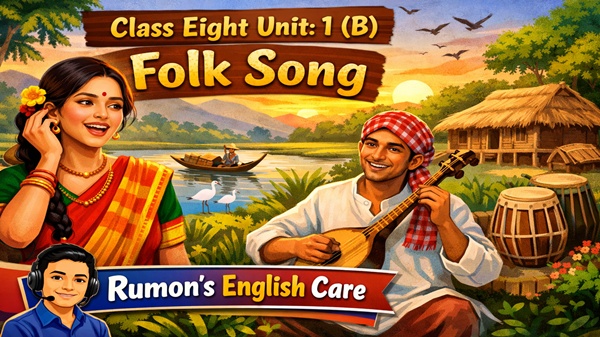
Unit: 1 Lesson 1(B) Folk Song
People’s music, also known as folk music, consists of tunes, lyrics, and knowledge passed down orally for generations. Over time, this music has evolved, agriculture, food, ecology, seasons, and rituals are closely tied to the way way people live. Our all reflected in these songs. P s. Palligiti, Bhatiwali. Jari, Sari, Gambhira, Lalon Giti, Paalagan, and the songs of Hason Raja all embody the self-expression of the people.
As the landscape changes, the music shifts too. In the hill tracts, you encounter music with the same role but expressed in the diverse languages of the ethnic communities. The instruments used for folk music are crafted from materials found in the surroundings-animal skin, bamboo, and calabash are ice are deeply connected to the land they come from. As common examples. The sounds they produce are cities and villages transform, these traditional tunes are slowly fading. However, folk people migrate to cities music still finds its place in mainstream films and music albums.
Bengali Meaning (বাংলা অর্থ):
জনগণের সঙ্গীত, যা লোকসংগীত নামেও পরিচিত, প্রজন্মের পর প্রজন্ম ধরে মুখে মুখে প্রচলিত সুর, কথা ও জ্ঞানের সমষ্টি। সময়ের সাথে সাথে এই সঙ্গীতের বিবর্তন ঘটেছে। মানুষের জীবনযাপনের সঙ্গে কৃষি, খাদ্যাভ্যাস, পরিবেশ, ঋতু ও বিভিন্ন আচার-অনুষ্ঠান ঘনিষ্ঠভাবে জড়িত, আর এসবই এই গানগুলোর মধ্যে প্রতিফলিত হয়। পাল্লীগীতি, ভাটিয়ালি, জারি, সারি, গম্ভীরা, লালনগীতি, পালাগান এবং হাসন রাজার গান—সবই মানুষের আত্মপ্রকাশের বহিঃপ্রকাশ।
প্রকৃতির দৃশ্যপট পরিবর্তনের সঙ্গে সঙ্গে সঙ্গীতের রূপও বদলে যায়। পার্বত্য অঞ্চলে একই ভূমিকা পালনকারী সঙ্গীত দেখা যায়, তবে তা বিভিন্ন ক্ষুদ্র নৃগোষ্ঠীর ভাষায় প্রকাশিত হয়। লোকসংগীতে ব্যবহৃত বাদ্যযন্ত্রগুলো আশপাশে পাওয়া উপকরণ দিয়ে তৈরি—যেমন পশুর চামড়া, বাঁশ ও কুমড়ো (লাউজাতীয় ফল)। এসব বাদ্যযন্ত্রের উৎপন্ন ধ্বনি তাদের উৎপত্তিস্থল ভূমির সঙ্গে গভীরভাবে যুক্ত।
শহর ও গ্রাম পরিবর্তিত হওয়ার সঙ্গে সঙ্গে এসব ঐতিহ্যবাহী সুর ধীরে ধীরে হারিয়ে যাচ্ছে। তবে লোকজন শহরে অভিবাসিত হলেও লোকসংগীত এখনও মূলধারার চলচ্চিত্র ও সঙ্গীত অ্যালবামে তার স্থান করে নিচ্ছে।
50 Pieces Vocabulary
| No. | Word | Bengali Meaning | Synonym | Antonym | Parts of Speech |
|---|---|---|---|---|---|
| 1 | People | মানুষ | human, public | individual | Noun |
| 2 | Folk | লোকজ | traditional | modern | Adjective |
| 3 | Music | সঙ্গীত | melody | silence | Noun |
| 4 | Tune | সুর | melody | discord | Noun |
| 5 | Lyrics | গানের কথা | words | silence | Noun |
| 6 | Knowledge | জ্ঞান | wisdom | ignorance | Noun |
| 7 | Orally | মুখে মুখে | verbally | written | Adverb |
| 8 | Generations | প্রজন্মসমূহ | descendants | ancestors | Noun |
| 9 | Evolved | বিকশিত | developed | declined | Verb |
| 10 | Agriculture | কৃষি | farming | industry | Noun |
| 11 | Ecology | পরিবেশবিদ্যা | environment | pollution | Noun |
| 12 | Seasons | ঋতুসমূহ | periods | timelessness | Noun |
| 13 | Rituals | আচার-অনুষ্ঠান | customs | neglect | Noun |
| 14 | Reflected | প্রতিফলিত | shown | hidden | Verb |
| 15 | Songs | গান | music | silence | Noun |
| 16 | Embody | প্রতিফলিত করা | represent | conceal | Verb |
| 17 | Expression | প্রকাশ | manifestation | suppression | Noun |
| 18 | Landscape | ভূদৃশ্য | scenery | emptiness | Noun |
| 19 | Changes | পরিবর্তন | transformation | stability | Noun |
| 20 | Diverse | বৈচিত্র্যময় | varied | similar | Adjective |
| 21 | Languages | ভাষাসমূহ | tongues | silence | Noun |
| 22 | Communities | সম্প্রদায় | groups | isolation | Noun |
| 23 | Instruments | বাদ্যযন্ত্র | tools | voice | Noun |
| 24 | Crafted | তৈরি করা | made | destroyed | Verb |
| 25 | Materials | উপকরণ | substances | waste | Noun |
| 26 | Surroundings | পরিবেশ | vicinity | distance | Noun |
| 27 | Bamboo | বাঁশ | cane | metal | Noun |
| 28 | Animal skin | পশুর চামড়া | hide | fur | Noun |
| 29 | Connected | সংযুক্ত | linked | separated | Adjective |
| 30 | Land | ভূমি | soil | sea | Noun |
| 31 | Produce | উৎপন্ন করা | create | destroy | Verb |
| 32 | Sounds | শব্দ | noise | silence | Noun |
| 33 | Cities | শহর | urban area | village | Noun |
| 34 | Villages | গ্রাম | rural area | city | Noun |
| 35 | Transform | রূপান্তরিত হওয়া | change | remain | Verb |
| 36 | Traditional | ঐতিহ্যবাহী | customary | modern | Adjective |
| 37 | Fading | বিলুপ্ত হওয়া | disappearing | emerging | Verb |
| 38 | However | তবে | but | therefore | Conjunction |
| 39 | Migrate | স্থানান্তরিত হওয়া | move | stay | Verb |
| 40 | Mainstream | মূলধারা | popular | marginal | Adjective |
| 41 | Films | চলচ্চিত্র | movies | drama | Noun |
| 42 | Albums | অ্যালবাম | collections | singles | Noun |
| 43 | Role | ভূমিকা | function | insignificance | Noun |
| 44 | Encounter | সম্মুখীন হওয়া | face | avoid | Verb |
| 45 | Ethnic | নৃগোষ্ঠীগত | tribal | universal | Adjective |
| 46 | Hill tracts | পার্বত্য অঞ্চল | highlands | plains | Noun |
| 47 | Example | উদাহরণ | instance | exception | Noun |
| 48 | Slowly | ধীরে ধীরে | gradually | quickly | Adverb |
| 49 | Place | স্থান | position | nowhere | Noun |
| 50 | Culture | সংস্কৃতি | tradition | barbarism | Noun |
A. Multiple Choice Questions (50 MCQs)
-
What is another name for people’s music?
a) Classical music
b) Folk music ✅
c) Pop music
d) Jazz -
How is folk music traditionally passed down?
a) Written manuscripts
b) Internet
c) Orally ✅
d) Radio -
Folk music evolves over time according to:
a) Weather only
b) Agriculture, food, ecology, seasons, and rituals ✅
c) Politics only
d) Movies -
Palligiti is a type of:
a) Dance
b) Folk song ✅
c) Instrument
d) Festival -
Lalon Giti represents:
a) Classical music
b) Religious chant
c) Folk music ✅
d) Western music -
Which of these is NOT mentioned as a folk song type?
a) Bhatiwali
b) Jari
c) Rock ✅
d) Gambhira -
Folk music is closely tied to:
a) Industrialization
b) People’s lifestyle ✅
c) Technology
d) Urbanization -
In the hill tracts, folk music is expressed in:
a) Same language everywhere
b) Diverse languages of ethnic communities ✅
c) Only Bengali
d) English -
Traditional instruments are made from:
a) Plastic
b) Metals only
c) Natural materials like bamboo, animal skin, calabash ✅
d) Glass -
Folk music instruments are deeply connected to:
a) Urban areas
b) The land they come from ✅
c) Technology
d) Schools -
What happens to folk music as cities and villages transform?
a) It disappears entirely
b) It slowly fades ✅
c) It becomes louder
d) It becomes classical -
Where does folk music still find its place?
a) Movies and music albums ✅
b) Factories
c) Only rural homes
d) Internet forums -
Which instrument material is NOT mentioned?
a) Bamboo
b) Calabash
c) Plastic ✅
d) Animal skin -
Gambhira songs originate from:
a) Hill tracts
b) Local villages ✅
c) Cities
d) Rivers -
Folk music expresses:
a) Wealth of people
b) Self-expression of people ✅
c) Political power
d) Modern fashion -
Bhatiwali songs are related to:
a) River life ✅
b) Mountain life
c) Urban life
d) School songs -
Jari songs are mostly:
a) Love songs
b) Religious or historical songs ✅
c) Pop songs
d) Dance songs -
Paalagan songs are related to:
a) Heroic stories ✅
b) Modern drama
c) Movies
d) Technology -
As people migrate to cities, folk music:
a) Disappears completely
b) Finds its way into mainstream media ✅
c) Becomes classical
d) Becomes electronic -
Folk music is an example of:
a) Oral tradition ✅
b) Written tradition
c) Digital music
d) Radio broadcast -
Which is a major factor affecting folk music evolution?
a) Politics
b) Changing landscape ✅
c) Fashion
d) Movies -
Folk music instruments are mostly:
a) Electrically powered
b) Handmade ✅
c) Imported
d) Factory-made -
Folk music reflects:
a) People’s emotions, culture, and lifestyle ✅
b) Only religion
c) Modern technology
d) Sports -
Lalon Giti was composed by:
a) Hason Raja
b) Lalon ✅
c) Rabindranath Tagore
d) Shah Abdul Karim -
Which type of folk music is associated with dance?
a) Sari ✅
b) Lalon Giti
c) Jari
d) Paalagan -
Which is true about folk music?
a) It is static
b) It changes over time ✅
c) It never moves to cities
d) It uses only modern instruments -
Folk music instruments are made from local materials because:
a) Imported instruments are expensive
b) They are deeply connected to their surroundings ✅
c) Plastic is unavailable
d) It is easier to transport -
Folk music songs reflect:
a) Fashion trends
b) People’s rituals and daily life ✅
c) Political campaigns
d) Movies -
Folk music continues in cities because:
a) People forget old songs
b) It appears in films and music albums ✅
c) Rural people resist it
d) It is broadcast on radio only -
Which of these is an example of a Bengali folk song?
a) Lalon Giti ✅
b) Rock
c) Pop
d) Jazz -
Folk music in the hill tracts is expressed in:
a) Only Bengali
b) Various local languages ✅
c) English
d) Hindi -
Which material is natural for making folk instruments?
a) Steel
b) Bamboo ✅
c) Plastic
d) Silicon -
Folk music instruments produce sounds connected to:
a) Their material and origin ✅
b) Electricity
c) Microphones
d) Digital effects -
Folk music is slowly fading because:
a) Urbanization and city transformation ✅
b) People dislike music
c) Instruments are unavailable
d) Climate change -
Which of these is a form of oral knowledge?
a) Folk music ✅
b) Printed book
c) TV show
d) Online article -
Folk music instruments are often made from:
a) Bamboo, calabash, animal skin ✅
b) Iron and plastic
c) Gold and silver
d) Synthetic fibers -
Folk music can appear in:
a) Only rural areas
b) Mainstream films ✅
c) Only schools
d) Government offices -
Which song type reflects heroic stories?
a) Paalagan ✅
b) Bhatiwali
c) Palligiti
d) Sari -
The text describes folk music as:
a) Evolving ✅
b) Static
c) Industrial
d) Digital -
Folk music instruments are:
a) Always imported
b) Crafted from local materials ✅
c) Electronic only
d) Found in shops only -
Which folk music is linked with rivers?
a) Bhatiwali ✅
b) Lalon Giti
c) Gambhira
d) Paalagan -
Which folk music is linked to spiritual expression?
a) Lalon Giti ✅
b) Jari
c) Sari
d) Bhatiwali -
Folk music shows the connection between:
a) People and land ✅
b) Technology and fashion
c) Cities and highways
d) Sports and science -
As folk music moves to cities:
a) It vanishes
b) It adapts into mainstream media ✅
c) It loses meaning
d) It is banned -
What is Sari?
a) Folk dance and song ✅
b) Instrument
c) Movie
d) Instrument material -
Folk music instruments reflect:
a) Local materials and culture ✅
b) Globalization
c) Modern factories
d) Only cities -
Which of these is true about folk music lyrics?
a) Written in books only
b) Passed orally ✅
c) Only for festivals
d) Always modern -
Gambhira songs are mostly:
a) Dance and satire ✅
b) Electronic
c) Classical
d) Pop -
Folk music is part of:
a) Oral tradition and culture ✅
b) Modern technology
c) Urban fashion
d) Industrial work -
Folk music is fading slowly because:
a) Cities and villages transform ✅
b) People dislike it
c) Instruments are unavailable
d) Internet replaces it
Answer the following questions (10)
1. What is people’s music?
Answer:
People’s music, also known as folk music, is a form of music that consists of tunes, lyrics, and knowledge passed down orally from generation to generation.
2. How is folk music transmitted from one generation to another?
Answer:
Folk music is transmitted orally, meaning it is passed down by word of mouth over generations.
3. What aspects of life are reflected in folk music?
Answer:
Agriculture, food habits, ecology, seasons, rituals, and the everyday life of people are reflected in folk music.
4. Name some forms of folk music mentioned in the passage.
Answer:
Some forms of folk music mentioned are Palligiti, Bhatiwali, Jari, Sari, Gambhira, Lalon Giti, Paalagan, and the songs of Hason Raja.
5. How does the landscape influence folk music?
Answer:
As the landscape changes, the style and expression of folk music also change to match the environment and way of life of the people.
6. What kind of folk music is found in the hill tracts?
Answer:
In the hill tracts, folk music exists in diverse forms and is expressed in the different languages of the ethnic communities.
7. What materials are used to make folk musical instruments?
Answer:
Folk musical instruments are made from natural materials such as animal skin, bamboo, and calabash found in the surroundings.
8. Why are traditional folk tunes slowly fading?
Answer:
Traditional folk tunes are slowly fading because cities and villages are transforming due to modernization.
9. Does folk music still have a place in modern society?
Answer:
Yes, folk music still has a place in modern society as it appears in mainstream films and music albums.
10. Why is folk music deeply connected to the land?
Answer:
Folk music is deeply connected to the land because its instruments, sounds, and themes come directly from the natural surroundings and lifestyle of the people.
Fill in the blanks with suitable words from the text:
People’s music, also known as folk music, consists of tunes and (a) ______ passed down (b) ______ from generation to generation. This music reflects agriculture, food, ecology, seasons and (c) ______ of the people. Folk musical instruments are made from natural materials like animal skin, (d) ______ and calabash. Though traditional tunes are slowly (e) ______, folk music still finds its place in mainstream films and music albums.
✅ Answer Key
(a) lyrics
(b) orally
(c) rituals
(d) bamboo
(e) fading
Passage–1
People’s music is closely connected with the way people (a) ______. Over time, this music has (b) ______ and reflected agriculture, food and ecology. Different forms like Palligiti, Bhatiwali and Jari (c) ______ the self-expression of the (d) ______. These songs are passed down from generation to (e) ______.
Answer:
(a) live (b) evolved (c) embody (d) people (e) generation
Passage–2
As the (a) ______ changes, the music also changes. In the hill tracts, folk music is expressed in the (b) ______ languages of ethnic communities. The instruments are made from materials found in the (c) ______. Animal skin and (d) ______ are commonly used. These instruments produce unique (e) ______.
Answer:
(a) landscape (b) diverse (c) surroundings (d) bamboo (e) sounds
Passage–3
Folk music reflects the (a) ______ life of people. Agriculture, seasons and (b) ______ are closely related to these songs. The music shows the culture and (c) ______ of the people. Over time, some traditional tunes are slowly (d) ______, but folk music still survives in modern (e) ______.
Answer:
(a) daily (b) rituals (c) tradition (d) fading (e) society
Passage–4
In villages, folk music is an important part of people’s (a) ______. Though cities and villages are (b) ______, these traditional songs still exist. Many folk musicians (c) ______ to cities, but their music finds a place in mainstream (d) ______ and music (e) ______.
Answer:
(a) culture (b) transforming (c) migrate (d) films (e) albums
Passage–5
Folk musical instruments are (a) ______ from natural materials. These instruments are deeply (b) ______ with the land. The sounds they (c) ______ reflect the life of the people. Though modernization has caused some changes, folk music has not completely (d) ______. It still plays a (e) ______ role in our culture.
Answer:
(a) crafted (b) connected (c) produce (d) disappeared (e) significant