
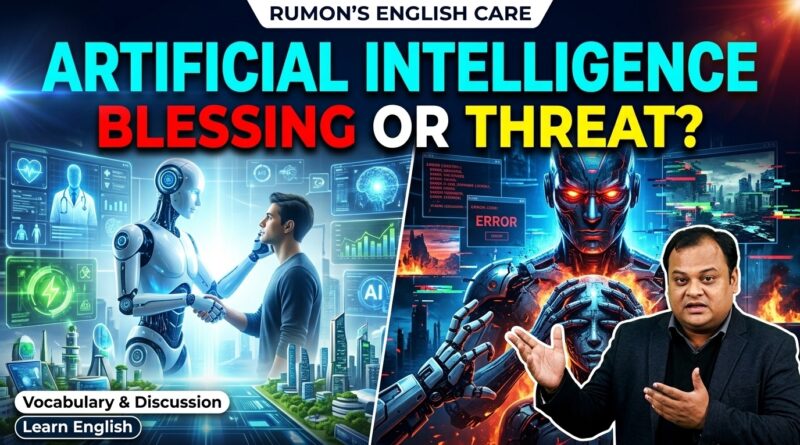
Artificial Intelligence: Blessing or Threat
Artificial Intelligence: Blessing or Threat [600 Words]
[Scroll to find another 500 & 450 words]
Artificial Intelligence (AI) is one of the greatest achievements of modern science. It refers to the ability of machines and computer systems to perform tasks that normally require human intelligence. These tasks include learning, reasoning, problem-solving, understanding language, recognizing images, and making decisions. Today, AI is becoming an important part of our daily lives. It is used in education, healthcare, agriculture, business, transportation, communication, and entertainment. However, AI has both positive and negative effects. Therefore, an important question arises: Is Artificial Intelligence a blessing or a threat?
There is no doubt that AI can be a great blessing to humanity. In the field of education, AI helps students learn according to their needs. It can explain difficult lessons, correct mistakes, translate languages, and provide useful learning materials. Teachers can also use AI to prepare lessons, exercises, and educational resources. In healthcare, AI can help doctors analyze medical information, identify diseases, and support medical research. It can assist in detecting certain diseases at an early stage and help researchers develop new treatments.
AI is also making agriculture more efficient. Farmers can use intelligent systems to monitor crops, identify diseases, predict weather conditions, and manage irrigation. In industries and factories, robots powered by AI can perform repetitive or dangerous tasks. This can improve productivity and reduce risks to workers. AI-powered navigation systems help people find routes and avoid traffic. In banks and online services, AI can detect unusual activities and help protect users from fraud.
Moreover, AI makes communication faster and easier. Translation tools can help people communicate across different languages. Voice assistants can answer questions and perform simple tasks. AI can also help people with disabilities by providing speech recognition, text-to-speech services, and other assistive technologies. In times of natural disasters, AI can analyze information and support disaster management. Thus, when used properly, AI can save time, increase efficiency, and improve many aspects of human life.
On the other hand, AI also creates some serious concerns. One major concern is employment. Some jobs that mainly involve repetitive tasks may gradually be performed by machines. As a result, some workers may need to learn new skills to adapt to changing workplaces. Another concern is privacy. AI systems can process enormous amounts of personal information, and careless or improper use of such data may threaten people’s privacy.
AI can also spread misinformation when it is used irresponsibly. Artificially generated images, audio, and videos can sometimes make false information appear convincing. This may create confusion and make it difficult for people to distinguish reliable information from false content. There are also concerns about overdependence on AI. If students or workers depend on AI for every task, they may fail to develop important skills such as independent thinking, creativity, and problem-solving.
Another important issue is the misuse of AI. People may use AI for fraud, cybercrime, manipulation, or other harmful activities. Therefore, governments, educational institutions, technology companies, and ordinary users need to promote responsible and ethical use of AI. Clear rules, human supervision, digital literacy, and respect for privacy are necessary to reduce its risks.
In conclusion, Artificial Intelligence is neither completely a blessing nor completely a threat. Its impact depends largely on how human beings develop, control, and use it. If AI is used responsibly, ethically, and for the welfare of humanity, it can bring enormous benefits to society. At the same time, its risks must not be ignored. We should welcome useful technological progress while maintaining human judgment, responsibility, creativity, and values. The future of AI will ultimately depend not only on what machines can do, but also on how wisely people choose to use them.
or, [500 Words]
Artificial Intelligence, commonly known as AI, is one of the most remarkable inventions of modern science. It is a technology that enables computers and machines to perform tasks that usually require human intelligence. AI can learn from information, recognize patterns, understand language, solve problems, and make decisions. At present, AI is being used in almost every important sector of life. It has brought many benefits, but it has also created several risks. Therefore, AI can be considered both a blessing and a threat depending on how people use it.
AI is a great blessing in the field of education. Students can use AI-based tools to understand difficult topics, learn new languages, correct their mistakes, and collect information quickly. Teachers can also use AI to prepare lessons, questions, and educational materials. In healthcare, AI helps doctors analyze medical information and detect certain diseases. It also supports medical research and helps researchers develop better methods of treatment.
AI has also brought significant changes to agriculture and industry. Farmers can use intelligent technology to monitor crops, predict weather conditions, identify diseases, and improve irrigation. In factories, AI-powered machines and robots can perform repetitive or dangerous tasks efficiently. As a result, production can become faster and more accurate. In transportation, AI helps with navigation, traffic management, and route planning. It can also improve safety by assisting drivers and transport authorities.
Communication and daily life have become easier because of AI. Translation systems can help people communicate in different languages. Voice assistants can answer questions and perform simple tasks. AI can also help people with disabilities through speech recognition and other assistive technologies. During natural disasters, AI can analyze information and help authorities make quicker decisions. Thus, AI can save time, reduce human effort, and improve the quality of many services.
However, AI also has some negative sides. One of the major concerns is unemployment. Machines may replace humans in some repetitive jobs, causing certain workers to lose employment or requiring them to learn new skills. Another concern is privacy. AI systems can collect and analyze large amounts of personal information. If such information is misused, people’s privacy may be endangered.
The misuse of AI is another serious problem. AI can be used to create false images, videos, or information that may mislead people. It can also be misused for fraud and other harmful activities. Moreover, excessive dependence on AI may reduce people’s ability to think independently and solve problems creatively. Students, in particular, should use AI as a learning aid rather than allowing it to do all their work.
Therefore, proper rules and responsible use of AI are essential. Governments, technology companies, teachers, parents, and users should work together to ensure that AI is developed and used ethically. Human judgment and responsibility should always remain important.
In conclusion, Artificial Intelligence is a powerful technology with both advantages and disadvantages. It can make our lives easier, improve education and healthcare, increase productivity, and solve many difficult problems. At the same time, it can create unemployment, privacy concerns, misinformation, and other risks. AI itself is neither entirely a blessing nor entirely a threat. Its effects depend on how wisely and responsibly human beings use it. If used for the welfare of humanity, AI can become a valuable tool for building a better future.
or, [450 Words]
Artificial Intelligence, or AI, is one of the most important inventions of modern science. It is a technology that enables machines and computers to perform tasks that normally require human intelligence. AI can learn from data, recognize patterns, understand language, solve problems, and make decisions. Today, it is being used in education, healthcare, agriculture, business, transportation, communication, and many other areas. Although AI has brought many benefits, it also has some harmful effects. So, it can be both a blessing and a threat to humanity.
AI is a great blessing in education. Students can use AI tools to understand difficult lessons, learn languages, correct mistakes, and find useful information. Teachers can also use AI to prepare lessons, questions, and educational materials. In the medical sector, AI helps doctors examine information, identify diseases, and support medical research. It can save time and assist healthcare professionals in making informed decisions.
AI is also useful in agriculture and industry. Farmers can use intelligent systems to monitor crops, identify diseases, predict weather conditions, and improve irrigation. In factories, robots can perform repetitive or dangerous jobs with speed and accuracy. AI is also used in transportation for navigation, traffic management, and route planning. It can make many services faster and more efficient.
In our everyday life, AI makes many activities easier. Voice assistants can answer questions and perform simple tasks. Translation tools help people communicate in different languages. AI can also provide useful support to people with disabilities. During natural disasters, AI can analyze large amounts of information and help authorities respond more effectively. Thus, AI can save time, reduce human effort, and improve the quality of life.
However, AI has some negative sides. One major concern is unemployment. Machines may replace people in some repetitive jobs, forcing workers to develop new skills. Another problem is privacy. AI systems can collect and analyze huge amounts of personal information. If such information is used improperly, people’s privacy may be threatened.
The misuse of AI is also dangerous. It can be used to produce false information, fake images, or misleading videos. Such content can confuse people and damage trust. Excessive dependence on AI may also weaken human creativity, independent thinking, and problem-solving skills. Therefore, people should not allow machines to make every decision for them.
To reduce these risks, AI should be used responsibly and ethically. Governments should establish appropriate rules, while technology companies should develop safer systems. Schools should teach students how to use AI properly. Human judgment, creativity, and responsibility should remain at the centre of technological development.
In conclusion, Artificial Intelligence is both a blessing and a potential threat. It can bring enormous benefits when used wisely, but irresponsible use can create serious problems. Therefore, we should not fear AI or depend on it blindly. We should use it carefully and responsibly for the welfare of humanity. The future of AI depends largely on the choices and actions of human beings.