
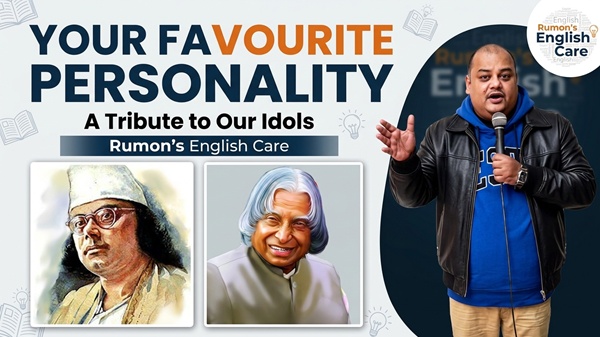
Your Favourite Personality
My Favourite Personality: The Eternal Rebel, Kazi Nazrul Islam [700 Words]
In the rich tapestry of Bengali culture, certain figures transcend their era to become timeless symbols of a people’s spirit. While many have contributed to the cultural and political landscape of Bengal, my favourite personality is the one who gave voice to the voiceless and stirred the conscience of a nation through the sheer power of his words. That personality is Kazi Nazrul Islam, the National Poet of Bangladesh, a man whose life and work embody rebellion, humanity, and an unyielding love for freedom.
Nazrul’s life is a testament to the idea that greatness can emerge from the most humble beginnings. Born into a poor Muslim family in 1899, he received only religious education and worked as a muezzin at a local mosque in his early years. This experience of poverty and religious grounding shaped his worldview, giving him a profound understanding of the struggles of the common people. He later worked with theatrical groups, which ignited his passion for literature and drama, setting him on a path to become one of the most powerful voices in Bengali literature. This journey from rural poverty to becoming the “Rebel Poet” is a powerful source of inspiration, reminding me that circumstances do not define one’s destiny; rather, it is the fire within that does.
What truly sets Nazrul apart, and makes him my favourite personality, is his role as a revolutionary. His poetry was not confined to the realm of aesthetic beauty; it was a weapon against injustice. His most famous poem, “Bidrohi” (The Rebel), is a clarion call for liberation, a thunderous declaration of defiance against all forms of tyranny and oppression. His works, such as “Bhangar Gaan” (The Song of Destruction), were so powerful that they were perceived as a direct threat by the British colonial rulers. He used his pen to assail the British Raj and preach revolution, which often led to his imprisonment.
Beyond his political rebellion, Nazrul was a fierce opponent of social and religious bigotry. He condemned Islamic fundamentalism, orthodox traditions, and all forms of superstition, advocating for a society based on equality and reason. His writings fiercely opposed gender discrimination, championing the rights of women in a deeply patriarchal society. This commitment to universal humanism makes him a timeless figure, whose message resonates even more powerfully today. Nazrul was a poet for all humanity, dedicated to the emancipation of the downtrodden masses of India and Bengal.
Nazrul’s genius was not limited to poetry. He was a prolific musician and composer, creating nearly 3,000 songs, which are collectively known as Nazrul Geeti (Nazrul Songs). These songs, covering themes from devotion and love to revolution and protest, form a significant part of the cultural heritage of Bangladesh and India. He pioneered new musical forms, including Bengali ghazals, and his compositions continue to be immensely popular, weaving the very fabric of Bengali music and culture. His work was a complete artistic expression of his philosophy.
The tragic end of his life adds a poignant layer to his story. At the age of 43, Nazrul was struck by an unknown disease, losing his voice and memory—a cruel fate for a poet whose greatest power was his words. He lived in isolation for many years, but his spirit remained unbroken. In 1972, the newly independent Government of Bangladesh invited him and his family to Dhaka, where he was declared the National Poet. He passed away four years later, but by then, his dream of a free Bengal—a dream he had fought for with his words—had become a reality.
In Kazi Nazrul Islam, I see the perfect embodiment of a revolutionary spirit, a champion of justice, and a poet of unparalleled genius. He was a man who dared to dream of a world free from oppression and used his art to fight for it. His life and work are a constant reminder that words have the power to change the world, and that the struggle for justice and equality is a noble calling. For his rebellion, his humanity, and his timeless music, Kazi Nazrul Islam will always remain my favourite personality—the eternal rebel whose fire continues to ignite the hearts of millions.
or,
My Favourite Personality: Dr. A. P. J. Abdul Kalam [800 Words]
Among the countless personalities who have shaped the world, my favourite is Dr. A. P. J. Abdul Kalam, the eleventh President of India and one of the greatest scientists and visionaries of our time. His life story, from a humble beginning in a small coastal town to the highest office in the land, is a testament to the power of determination, hard work, and unwavering faith in oneself. He inspires me not only through his remarkable achievements but also through his humility, simplicity, and deep love for the youth of his nation.
Dr. Kalam was born on October 15, 1931, in Rameswaram, a small town in Tamil Nadu, India. His father was a boat owner and imam of a local mosque, and the family lived in modest circumstances. As a young boy, Kalam sold newspapers to support his education, demonstrating an early commitment to learning that would define his entire life. He studied physics and later aerospace engineering, driven by a fascination with flight and space. This humble beginning makes him relatable and proves that greatness is not a matter of birth but of effort and perseverance.
His contributions to science and technology are extraordinary. Dr. Kalam played a pivotal role in India’s space and missile programs. He was the project director of India’s first indigenous Satellite Launch Vehicle, which successfully placed the Rohini satellite in orbit. He led the development of the Agni and Prithvi missiles, earning him the title “Missile Man of India.” In 1998, he played a crucial organizational role in the Pokhran-II nuclear tests, which established India as a nuclear power. For his scientific achievements, he was awarded the Padma Bhushan, Padma Vibhushan, and ultimately the Bharat Ratna, India’s highest civilian honour.
What truly sets Dr. Kalam apart, however, is his character. Despite reaching the pinnacle of success, he remained remarkably humble and simple. He famously owned very few possessions, lived in modest accommodation even as President, and donated most of his salary to charity. He was a lifelong bachelor, dedicating his life entirely to his work and his country. His simplicity and integrity in public life are rare qualities that make him a role model in an age often dominated by materialism and self-interest.
Dr. Kalam was also a passionate educator and a source of inspiration for millions of young people. After his presidency, he returned to teaching and spent his remaining years visiting schools and universities, interacting with students, and encouraging them to dream big. His famous advice, “Dream, dream, dream—dreams transform into thoughts, and thoughts result in action,” has motivated countless young Indians to pursue ambitious goals. He believed that the youth are the future of the nation and that they possess the power to bring about positive change. His autobiography, “Wings of Fire,” has inspired generations of readers to overcome obstacles and strive for excellence.
Another quality that I deeply admire in Dr. Kalam is his vision for India. He proposed a bold plan called “Vision 2020,” aiming to transform India into a developed nation by the year 2020. He emphasized the importance of education, technology, and self-reliance. His vision extended beyond India; he was a global citizen who advocated for peace and cooperation among nations. He believed that science and technology should be used for the betterment of humanity, not for destruction.
Dr. Kalam’s life came to an end on July 27, 2015, while he was delivering a lecture to students in Shillong. Even in his final moments, he was doing what he loved most—teaching and inspiring young minds. His death was mourned across the nation and around the world, a testament to the profound impact he had on people’s lives.
In conclusion, Dr. A. P. J. Abdul Kalam is my favourite personality because he embodies the values of hard work, humility, integrity, and visionary leadership. His journey from poverty to presidency proves that with determination and dedication, nothing is impossible. He inspires me to dream big, to work hard, and to contribute positively to society. He taught us that true success lies not in what we accumulate but in what we give back to the world. For these reasons and countless more, Dr. Kalam will always remain a shining example for me and for generations to come.